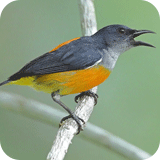
Chile may hold 45,000 Surfbirds in the non-breeding season
Targeted surveys of rocky shores suggest that one country supports a large share of the species, while exposing uncertainty in the long-used global estimate.

Chile may support about 45,000 Surfbirds during the non-breeding season, a new targeted survey suggests, placing a substantial share of the species along one country's rocky Pacific coastline.
The estimate, published in the November issue of the Journal of Field Ornithology, is the first model-based national total derived from surveys designed specifically around the Surfbird's preferred rocky intertidal habitat.
Thirty-eight trained observers surveyed 147 transects between 9 and 23 February 2025. The sampled sites totalled 84.5 km and were distributed across 13 regions from Arica y Parinacota south to Los Lagos, representing about 3% of the mapped rocky coast north of 43 degrees south.
"Chile supports approximately 45,000 Surfbirds, indicating that a substantial proportion of the global population occurs within a single country."
Erik Sandvig and study co-authors
Observers counted 1,218 Surfbirds at 21 transects in eight regions. A Bayesian model then accounted for the many sites with no detections, uneven coastline length and variation between regions, producing a median estimate of 45,000 birds.
The uncertainty is wide: the 95% credible interval runs from 20,000 to 107,000. Some regions with extensive rocky coast received substantial modelled totals even where few or no birds were counted because the hierarchical model drew those poorly sampled estimates towards the overall mean.
That makes the headline figure a reason for further work, not a replacement global count. The commonly cited world population of about 70,000 has changed little for two decades and is based largely on breeding and migration concentrations in Alaska. Chile alone approaching that total suggests it may need revision.
An earlier shorebird atlas estimated about 58,400 Surfbirds in Chile from surveys conducted in 2014, despite focusing more heavily on beaches. The similar order of the two independent estimates supports Chile's importance, but neither survey demonstrates a national increase or a stable global trend.
The species breeds in mountain areas of Alaska and north-western Canada, then uses rocky shores along the Pacific coast of the Americas. Those narrow habitats can hold predictable concentrations yet receive less standardised monitoring than beaches or estuaries.
The authors recommend repeating the Chilean census every three to five years, with annual counts at core locations, better coverage of poorly sampled regions and records of disturbance such as kelp harvesting. Comparable surveys elsewhere on the flyway are needed before the global population can be recalculated securely.
For conservation, the immediate conclusion is geographical: northern Chile, including Arica y Parinacota, Tarapaca and Antofagasta, is a major non-breeding stronghold whose rocky shores warrant systematic monitoring.
10 Nov 2026
Get Breaking Birdnews First
Get all the latest breaking bird news as it happens, download BirdAlertPRO for a 30-day free trial. No payment details required and get exclusive first-time subscriber offers.