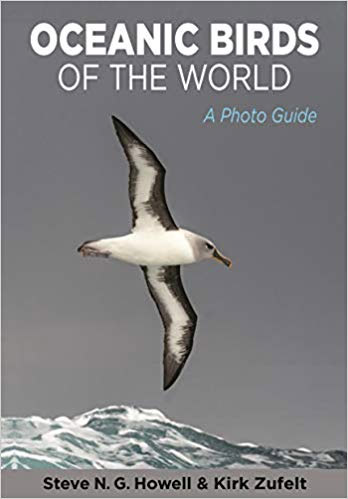
Oceanic Birds of the World - A Photo Guide
Steve N G Howell & Kirk Zufelt
For me, seabirds are the most rock’n’roll of any avian group on the planet. The gaudy world of wood-warblers from the Americas is all a bit glitzy and shiny, like a highly polished 80’s and 90’s boy-band/girl-band. Pittas and Bee-eaters feel curiously manufactured, like an in-your-face bubblegum K-Pop band; shorebirds have a gnarly well-travelled “blues-man” vibe; gulls give off that whole Death Row records, in your face hip-hop thing, and the big raptors of the world have a seriously hard rock feel. Seabirds? They are, unquestionably, the business. The ultimate garage band of the birding world, here’s a group of species which are so varied and diverse that each and every one of which will take you on a, literally at times, rock and roll journey of your own.
I have rocked and rolled around a few of the world’s oceans scanning over the crest of the next wave or deep in to the almost bottomless hollows of an oncoming trough, wondering what may loom in to my field of view. From on-board the M.V. Chalice, bobbing around the legendary “Wilson’s Triangle”, some 100 miles out from Scilly, the ropey old fishing boat churned around the washing-machine currents off the Cape of Good Hope, through to the Akademik Ioffe skirting the encroaching ice flows of the Weddell Sea within the Antarctic Peninsula, some of my favourite birding encounters have come thanks to members of the seabird tribe.
Now we have an all-encompassing (extraordinary) piece of work that should be packed within any self-respecting birder’s hand baggage for any seabird trip, be it land based or taking to the water in full-on pelagic mode. “Essential” is a much overused word in reviews of books, optics, records and whatever else you can think of, but here it’s a word that is right on the money in terms of what this book is. Essential isn’t the half of it.
Simply put, you’ll pick up this book and go “wow”. You’ll perhaps put the book down briefly, go back to it, leaf briskly through the pages and go “wow” once more. You might then sit down, delve ever deeper within this superb volume and go “wow” some more, over and over again as you digest the exceptional amount of work that has gone into compiling this definitive seabird photographic guide, the first of its kind for over two decades. The Godfather of seabirding, Peter Harrison, published his seminal “Seabirds: An identification Guide” in 1983 with the follow-up, companion guide “Seabirds of the World: A Photographic Guide” in 1987. There’s been little that’s been so in-depth with regard to the all of the planet’s pelagic species since.
Until now that is…
There have been a number of birding volumes over the years that have promised much but delivered little. There is absolutely no danger of that here as Steve Howell and Kirk Zufelt take you on a global pelagic tour (an at-sea tour de force in fact) that is informative, compelling, riveting and, above all else, the must-read book for 2019.
Few authors or photographers are better placed to deliver a product such as this. Steve Howell’s name is widely recognised as one of the foremost (sea)-birders on the planet whilst Kirk Zufelt, a physician by trade, is world-renowned for the quality of his images, capturing some of the hardest to see (and in some cases, identify) birds anywhere around the globe.
It starts well and gets better and better with almost every turn of the page. The glorious cover shot, a Gray-headed Albatross rising over a foaming sea is siren-like in the way in which it entices you inside. Each dip into the well laid-out pages is a hedonistic seabirding rush of information; taxonomy, distribution, range and, most important of all, identification are dealt with in supreme detail ~ Howell’s text is concise, crammed with information that act as a taster for the wealth of pin-sharp images taken, collected and curated by Zufelt.
Photographic guides are undoubtedly “on trend” once more, have snuck back in to authors’ and publishers’ thoughts across the last seven or eight years, after decades in the doldrums. Anglo-American birder Richard Crossley raised the bar with his highly stylised photo-identification guide to Eastern Birds (and he’s followed it up with three further published guides that follow the same format, with another in prep., too) and it’s this distinctive appearance (the “Crossley-style plates”) that seem to have been used as a successful template for the vast collection of simply brilliant photographs here, very many of which have been taken by either Kirk or Steve.
The quality of the images within the book is, at times, breathtaking. I sat here thinking of some of my pelagic trips and remembered how hard it was to keep my balance and keep my binoculars trained on a passing petrel, let alone have the wherewithal to wrangle a hefty camera and lens and then be able to produce some simply stunning collections of some of the least known species on the planet. Often you settle on a page or two of photos and alight on a favourite. Oceanic Birds of the World doesn’t give you that chance because the quality, from start to finish, is stellar (whether the species is a common one or one of the rarest we have).
The text is pithy (in a necessarily smart, clever way) and well thought out. This is, after all, a photographic guide, but the comment is intelligent and instructive, with a clarity that is to be welcomed given the dizzying array of subject species and “matters arising” that are covered across the 360 or so pages. For those with a quest for the basics and like to know what you get for your money, here’s a mini-breakdown of what you get…
A well explained “How to use this book” section is the essential starting point, tackling how the author’s have themselves tackled the eternally sticky area of seabird names, through to size estimation, the all-important identification pointers (helpfully highlighted throughout the volume) and more. The Introduction breaks down precisely what types of seabirds will be dealt with (12 family groups are dealt with in all) before dealing with how to identify birds at sea, where to see seabirds, conservation and moult. Text ID pointers are laid out within the photos and distribution maps are as clear as crystal. Some 270 species of “oceanic birds” are documented with the authors acknowledging the subjective nature of what is and what isn’t a species (and the controversy that all that entails) and, between them, Steve Howell and Kirk Zufelt have seen all but ten cryptic and recently described taxa.
Gull fans note, ditto those who have may have a love of terns, cormorants and pelicans, there’s not much for you here. As is pointed out by the authors, their definition of species for this book is grounded in taxonomy and the subtle distinction between seabirds and “seaside birds”. A seabird is a bird of the open ocean, one that you need to be out at sea to see.
At the heart of the book are, of course, the species accounts. Almost instantly, on the first pages of the first group, Penguins, I was transported to December 22nd 2012. That was when I found two “vagrant” ice-flow Emperor Penguins, stood alongside exquisite Adelie Penguins and the first two images of the “ruling penguins” pages were almost carbon copies of those taken by my friend Jen Owen on our Antarctic trip. Further recollections were stirred across many other pages, but this isn’t really a book for a dewey-eyed saunter along memory lane (although it is a great trigger for trips gone by). This is a contemporary identification guide and I’ve learnt something on every page I’ve read.
The handling of a myriad of complex species complexes and their taxonomy has to me, with no more than entry-level understanding of where seabird taxonomic theory is heading, was a revelation and the highlight of the book. Take Wandering Albatross as an example. I’d lost track at three species (widely accepted in litt., from 1983) but here Howell and Zufelt have upped it to five (Snowy, Gough, Gibson’s, Antipodes and Amsterdam), taking a mere 10 pages to do so with a remarkable 90 images to go with the text. Nothing feels cramped, clarity the watchword for both the text and images.
I was engrossed by their breakdowns of groups such as small black and white shearwaters (spread across 18 pages and sub-divided in to five groups, from Atlantic through both Indian and Pacific tropical regions, the Pacific subtropical zone to southern oceans) with a supreme collection of images to help join the dots set out by the text and maps. The Wilson’s Storm-petrel group was another to capture the imagination as I turned the pages (apologies, memory lane struck again ~ a brilliantly maniacal Peter Harrison bellowing “WILSON’S!!!”, looking ever so slightly unhinged, pointing an arm and a leg at an oncoming group of chum-lured storm-petrels whilst holding on to the Chalice railings with his other arm and leg) and…well, the list could go on and on as to which family groups to immerse yourself in.
The strong point throughout the text is the ease at which the really tough stuff (from ID criteria to the vexed taxonomic minefield) is explained. It’s “easier said than done” territory and here, whenever it looms, the explanations are laid out in such a way as to make all feel included, beginners and experts alike. I, for one, appreciated the Appendix, post species accounts, that details more on taxonomy and, in particular, some of the unfamiliar names afforded to some provisionally split species that feature within the book, a necessary and pleasing touch (for instance Harrison’s photographic guide from 32 years ago treated 107 different tubenoses, in 2019, Howell and Zufelt have dealt with in excess of 175).
You could almost write a novella about all the plus points that are documented in this new publication such is the richness of the subject matter within and how thoroughly Howell and Zufelt have gone about their business. It is telling to see glowing words upon the back cover from renowned US birder Ned Brinkley and also the doyen of the modern seabirding era, Scilly’s Bob Flood. To quote the latter, “…they pull together what is known about seabirds in a single text. The result is more than just a field guide…”. Yup, Bob nailed it right there.
Seabirding novices and seabirding stalwarts alike will surely gain a huge amount from this startling piece of work. The time and effort that the authors have put in to the book must surely be well in to the 1000’s of hours and how it shows. The very best birding books of the last 15 years have, for me, been four volumes that have (coincidentally) all focussed on seabirds; “Petrels Night and Day” from Magnus Robb, Killian Mullarney and the Sound Approach, along with the three volumes in the “North Atlantic Seabird” multimedia guides, by Bob Flood and Ashley Fisher, have all pushed boundaries in terms of a unique approach to the subject matter, design layout, and a quality of content highlighting the undoubted expertise of the people involved. Now, courtesy of Oceanic Birds of the World, we have a fifth, supreme, birding book.
It is hard to think that 2019 will be able offer up a better volume than this. A must for everyone’s bird book shelf.
Mark Golley

Share this review

Commission for Conservation
Rare Bird Alert does not profit from the sale of books through Wildsounds. Instead we are part of their Commission for Conservation programme where a percentage of every sale made through RBA helps supports BirdLife's Spoon-billed Sandpiper Fund.