Review: Birds in Winter: surviving the most challenging season
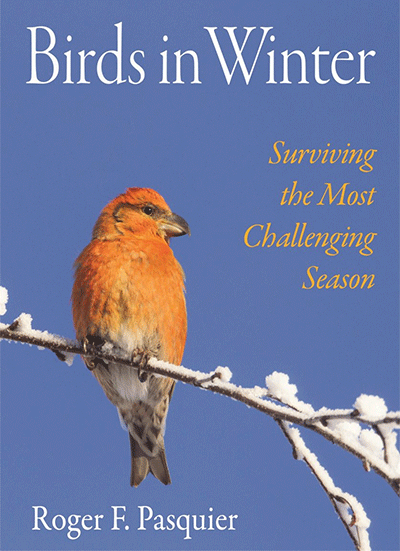
This book explores the ecology of birds in winter, how they prepare for and survive the challenges of the non-breeding season. The ways in which birds cope with the onset of winter is a vital element of their ecology. Birds spend longer, often considerably longer, on their wintering grounds than on their breeding grounds so their survival depends just as much, if not more, on what happens to them at this season.
The book’s brief is broad, encompassing not just the birds of northern latitudes which remain in cold environments and those which migrate to warmer climes but also those which never leave the tropics and share their habitat with visitors from elsewhere. Also included are those Southern Hemisphere species which move north during the southern winter.
Its chapters cover preparing for winter, ranges and habitat selection, spatial and social organisation, survival, ‘the winter day’, anticipating spring, and departure. Final (and inevitably somewhat depressing) sections address the multiplicity of conservation issues affecting wintering birds and the specific challenges posed by climate change.
The author is American and the content is therefore inevitably skewed towards Nearctic birds although the life stories of Western Palearctic species are also liberally scattered throughout. Featuring much more rarely are the wintering birds of Southeast Asia, a result - as the author admits - of a much sparser literature. The chapters contains a myriad of fascinating details which build up into a picture of astonishing complexity - a delicate web of relationships which has evolved over millions of years and which continues to do so today. We read, for example, of the precise habitat preferences of wintering American Redstarts, the nocturnal snow-burrowing of Arctic Redpolls and the daily movements of Mediterranean Gulls.
The author is an ornithologist at the American Museum of Natural History and this is therefore very much an academic desk research exercise, drawing extensively on the (scrupulously referenced) literature. The text is very dense, however, with new facts coming thick and fast. This rather ‘dry’ treatment means that it is probably best read in short segments rather than at a single sitting.
Published: Princeton University Press
hardback
ISBN: 9780691178554
RRP: £24.00
SPECIAL OFFER:
£17.99 Quote discount code RBABOTW
Offer ends: 20 Oct

There are no photographs but the text is enlivened by some attractive, albeit rather rudimentary, pen and ink sketches. I noticed an error in the captioning of the Yellow Wagtails drawing where the labelling of the depicted subspecies is incorrect.
This book is a masterful summary of the literature. Its scope is vast but the daunting task of drawing together and structuring such a large information resource has been achieved in impressive style. As a reference for the general reader on the ecology of winter birds, this work will be invaluable.
Andy Stoddart
15 October 2019
Share this review

Commission for Conservation
Rare Bird Alert does not profit from the sale of books through Wildsounds. Instead we are part of their Commission for Conservation programme where a percentage of every sale made through RBA helps supports BirdLife's Spoon-billed Sandpiper Fund.